


Views: 0 Author: Site Editor Publish Time: 2026-07-07 Origin: Site


TL;DR:
The Toyota engine mount 12305-23010 is a precision rubber-to-metal component that isolates engine vibration from the vehicle chassis. It fits several Toyota models and typically requires replacement every 60,000–100,000 miles. Sourcing an OEM-grade part from a trusted manufacturer like Kaiping Suhong Auto Parts ensures durability, accurate fitment, and a long service life.
Engine mounts are among the most overlooked components in a vehicle's drivetrain system. They work silently, absorbing thousands of vibration cycles per minute, and most drivers never give them a second thought—until something goes wrong. A worn or cracked engine mount can cause excessive vibration, unusual clunking sounds, and accelerated wear on nearby components like the transmission and exhaust.
For Toyota owners, the 12305-23010 is a widely used OE part number covering multiple trims and model years. Understanding what this mount does, how to spot wear, and where to source a quality replacement can save significant time, money, and frustration down the road.


An engine mount—also called a motor mount—connects the engine to the vehicle's chassis and serves two critical functions. First, it holds the engine securely in place under acceleration, braking, and cornering forces. Second, it absorbs and dampens the vibration generated by the rotating engine, preventing it from transferring into the cabin.
Most engine mounts consist of a metal bracket bonded to a rubber or hydraulic damping element. The rubber compound is the key to performance. When it hardens, cracks, or separates from the metal, the mount loses its ability to dampen vibration—and that's when drivers start to notice the difference.
Catching a failing engine mount early prevents more expensive repairs later. Here are the most common warning signs:
Excessive cabin vibration: A noticeable increase felt through the steering wheel, floor, or seat—especially at idle—is one of the earliest indicators.
Clunking or thudding noises: A failed mount allows the engine to shift under load, producing a distinct clunk when accelerating, braking, or shifting gears.
Visible engine movement: With the hood open, ask a helper to engage and release the throttle. Excessive engine rocking is a clear sign the mount is no longer doing its job.
Engine misalignment: In severe cases, a broken mount can shift the engine enough to strain hoses, belts, or the exhaust system.
If your Toyota exhibits any of these symptoms, inspecting the engine mounts should be the first diagnostic step before assuming a more complex mechanical issue.
The 12305-23010 part number is compatible with several Toyota vehicles powered by the 2.4L 2AZ-FE engine. The table below outlines common applications:
Vehicle Model | Engine Type | Drive Type | Mount Position |
|---|---|---|---|
Toyota Camry (XV40) | 2AZ-FE 2.4L | FWD | Front/Left |
Toyota RAV4 (XA30) | 2AZ-FE 2.4L | FWD / AWD | Front/Left |
Toyota Highlander | 2AZ-FE 2.4L | FWD | Front |
Toyota Venza | 2AZ-FE 2.4L | FWD / AWD | Front/Left |
Toyota Estima | 2AZ-FE 2.4L | FWD | Front |
Always confirm fitment against your vehicle's VIN and production year before ordering.
Choosing the wrong engine mount—even one that looks similar—can result in improper load distribution and premature failure. Part number accuracy is non-negotiable.
Engine mount design varies considerably depending on the manufacturer's engineering priorities. Toyota mounts tend to prioritize long-term durability and NVH (noise, vibration, and harshness) control, while other brands make different trade-offs between stiffness and compliance.
Mazda, for instance, uses a distinct mount specification across its lineup. The GA2A-39-040 is a front engine mount used across several Mazda platforms fitted with SKYACTIV 2.0L and 2.5L engines. Like its Toyota counterpart, this part connects the front of the engine to the subframe and plays a central role in managing vibration under load. The key differences lie in the rubber compound formulation and bracket geometry—both engineered specifically to match the torque output and mounting architecture of each vehicle.
This is precisely why cross-brand compatibility is rare and why relying on the correct OE part number is essential to a successful repair.
Not all engine mounts are created equal, even when they share the same OE part number. The durability of any rubber mount depends heavily on the raw materials used in construction.
Kaiping Suhong Auto Parts Co., Ltd.—operating under the SUHON and DIDN brands—has specialized in engine mount manufacturing since 1995. Based in Kaiping City, Guangdong Province, the company holds ISO 9001 certification and sources its rubber exclusively from Thailand RSS3 and Vietnam SVR3L grades. These are among the highest-quality natural rubber classifications available, offering superior elasticity, heat resistance, and long-term fatigue performance.
For applications that demand OEM-grade durability, the difference between a generic aftermarket part and a Suhon-manufactured mount is measurable—both in laboratory testing and in real-world service life.
Suhon's catalog covers Toyota, Honda, Nissan, Mazda, Subaru, Renault, Benz, and BMW, with hundreds of part numbers in active production. For Subaru owners, the BR74-39-040 is one example of a Subaru-specific mount available through Suhon's product range, manufactured to the same rigorous material standards as its Toyota and Mazda counterparts.

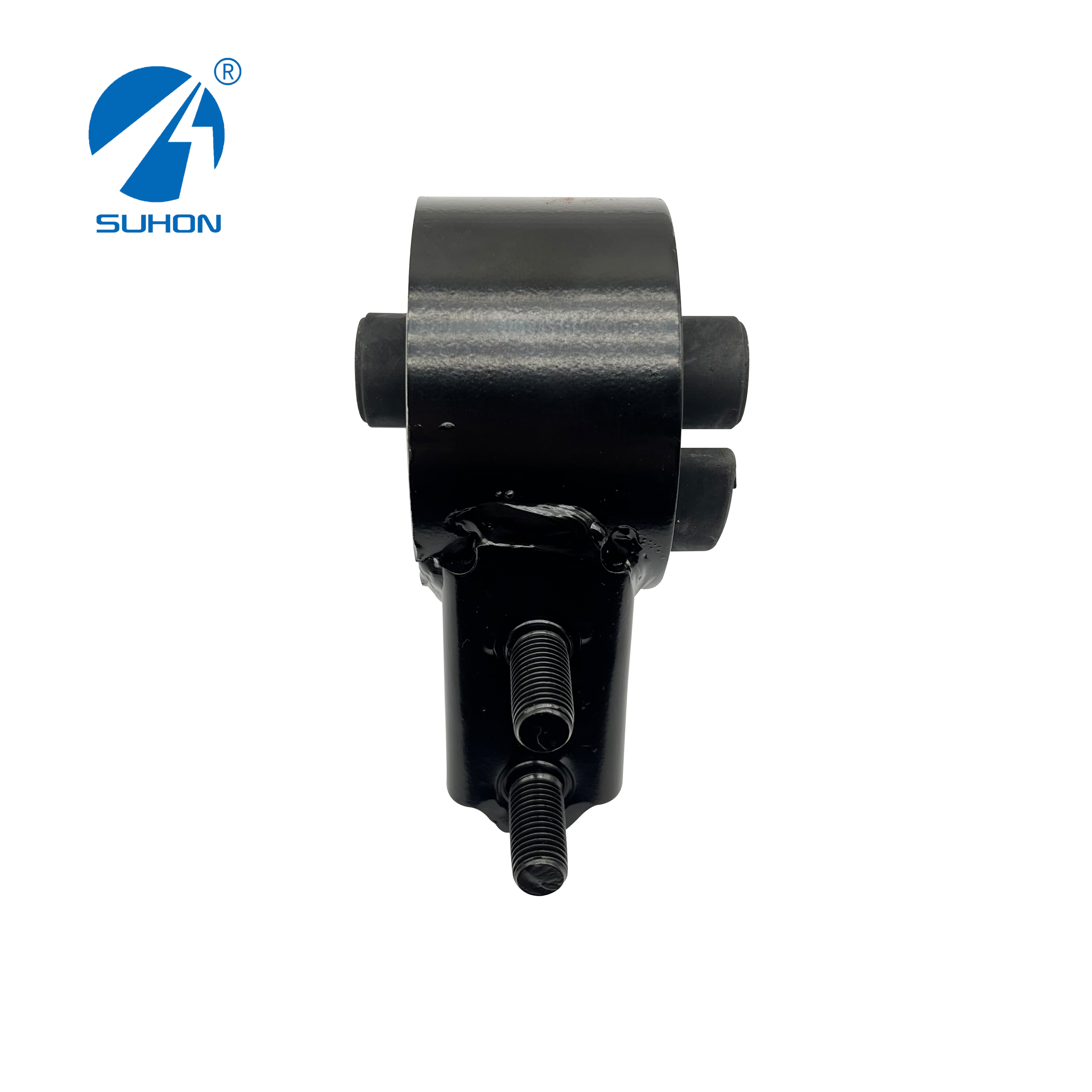
Engine mount replacement ranges from straightforward to moderately complex, depending on the vehicle and mount location. Here's a general process:
Support the engine using a floor jack with a wooden block under the oil pan to take the engine's weight before removing the mount.
Remove the mounting hardware by unbolting the mount from both the engine bracket and the chassis or subframe.
Inspect the surrounding area for rubber debris, fluid contamination, or cracked brackets while the mount is out.
Install the new mount and torque all fasteners to the manufacturer's specification—under- or over-tightening can cause premature failure.
Test drive through a range of conditions, including acceleration, braking, and low-speed cornering, to confirm the vibration has been resolved.
If any step is unclear, having a qualified mechanic perform the replacement is always the right call.
A failed engine mount doesn't just cause vibration—it puts stress on the entire drivetrain. When the engine shifts under load, it accelerates wear on the transmission mounts, CV axles, exhaust flex joints, and coolant hoses. Replacing a worn mount promptly, and with a quality part, is one of the most cost-effective preventive maintenance decisions a vehicle owner can make.
For buyers sourcing replacement mounts in volume, Kaiping Suhong Auto Parts offers direct factory pricing with consistent quality control, backed by more than 25 years of manufacturing experience. Reach the Suhon team via email at junz@suhonauto.com or WhatsApp at +86-18138671291 to request product specifications and availability.
The 12305-23010 Toyota engine mount is commonly used in 2.4L 2AZ-FE applications, including the Camry (XV40), RAV4 (XA30), Highlander, Venza, and Estima. Always verify compatibility using your vehicle's VIN and production year before purchasing.
Engine mounts typically last between 60,000 and 100,000 miles. Heat exposure, driving conditions, and rubber quality all influence service life. Vehicles driven in hot climates or subjected to frequent heavy loads may see earlier degradation.
Driving with a failed engine mount is not recommended. The engine can shift under acceleration and braking, which risks damaging the transmission, exhaust system, and surrounding hoses and brackets over time.
The main factors are rubber compound quality, metal bracket integrity, and dimensional accuracy. Mounts made with high-grade natural rubber—such as Thailand RSS3 or Vietnam SVR3L—offer better elasticity and fatigue resistance than those made with lower-grade synthetic compounds.
Kaiping Suhong Auto Parts Co., Ltd. manufactures OEM-grade engine mounts for Toyota and other major brands. Products are available directly from the factory at suhonauto.com, with sales support available via WhatsApp and email.


